 |
|
Our Colonial History |
|
"These things have I spoken unto you, that ye should not be offended. They shall put you out of the synagogues: yea, the time cometh, that whosoever killeth you will think that he doeth God service. And these things will they do unto you, because they have not known the Father, nor Me. But these things have I told you, that when the time shall come, ye may remember that I told you of them." Jesus Christ, John 16:1-4. |
|
Settlement of the Northern Colonies (con't)Pennsylvania was explored under the British by John Cabot in 1497; under the Dutch West India Company by Henry Hudson in 1609; and under the New Sweden Comapny in 1638. By 1644 Swedish and Finnish settlers were living along the western shore of the Delaware River. In 1655 the Dutch attacked the Swedish settlements and incorporated them back into New Netherland. But they didn't hold the territory long, as the British decided to reclaim the land, and in 1664 the brother of British King Charles II ousted the Dutch from both the Delaware and Hudson River settlements. Into this turbulent and diverse political environment came William Penn and his Quakers. On March 4, 1681, Charles II, King of England, granted Penn Willian Penn himself had been imprisoned many times in England for preaching Quakerism in an "unlawful assembly." Following one arrest he pleaded his right, by English law, to examine the written charges placed against him. This was denied and he was sent to trial. The judge instructed the jury to find Penn guilty as charged, but they returned a not guilty verdict. As a result, the judge sent not only Penn to jail, but also imprisoned the entire jury. Members of the jury petitioned and won their case, with the notable consequence that English law would afterward include the writ of habeas corpus and the right of jury nullification. These principles later were incorporated into the U.S. Constitution, Article I, Section 9. "I consider trial by jury as the only anchor yet imagined by man by which a government can be held to the principles of its Constitution." Thomas Jefferson, 1789. Not everyone in the American colonies was glad to have William Penn as a neighbor. Cotton Mather, a socially and politically influential New England Puritan minister and author who wrote profusely on religious topics, was not only outspoke against the Quakers coming to the American shores, but actively worked to prevent the "Quaker heresy" from entering the New World. In a letter written in 1682 while Penn was enroute to settle his colony, Mather outlined an astonishing plan for preventing Penn and his fellow colonists from landing. |
|
Sept. 15, 1682 |
|
William Penn did land safely in this country. When he immigrated to America, Penn brought with him all of his experience of persecution and religious intolerance. This experience and his religious beliefs would determine how he governed his colonial settlement. Under Penn the colony's reputation of religious freedom also attracted significant populations of German and Scots-Irish settlers who where escaping persecution in their homeland. These varied cultures and diverse faiths helped to shape colonial Pennsylvania's character. All the culmulative experiences of the founding fathers ultimately added to the storehouse of knowledge that shaped the U.S. Constitution. |
|
Learn more about the Constitutional Convention (coming soon) |
|
Read the Bill of Rights — Ten Guarantees for American Freedom |
|
| About Questions on Doctrine | History of Christianity | Points of Interest |
|
Issues on Religious Freedom | American Heritage | America in Prophecy |
|
| cfi©2000-2009 | Contact the Webmaster |
|
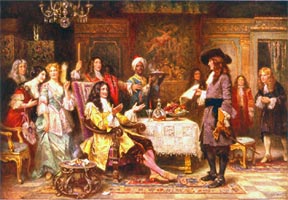 a large tract of land to expunge a debt Charles owed to Penn's father (see side image depicting Penn standing before King Charles receiving the land grant). Penn was a member of the Religious Society of Friends, also known as Quakers. The Quakers were a non-conformist spin-off from English Puritanism who objected to state sanctioned religion. This brought them under persecution as the sect expanded in England. When Penn was glad to remove himself to America, King Charles was equally glad to see him and his problems go.